









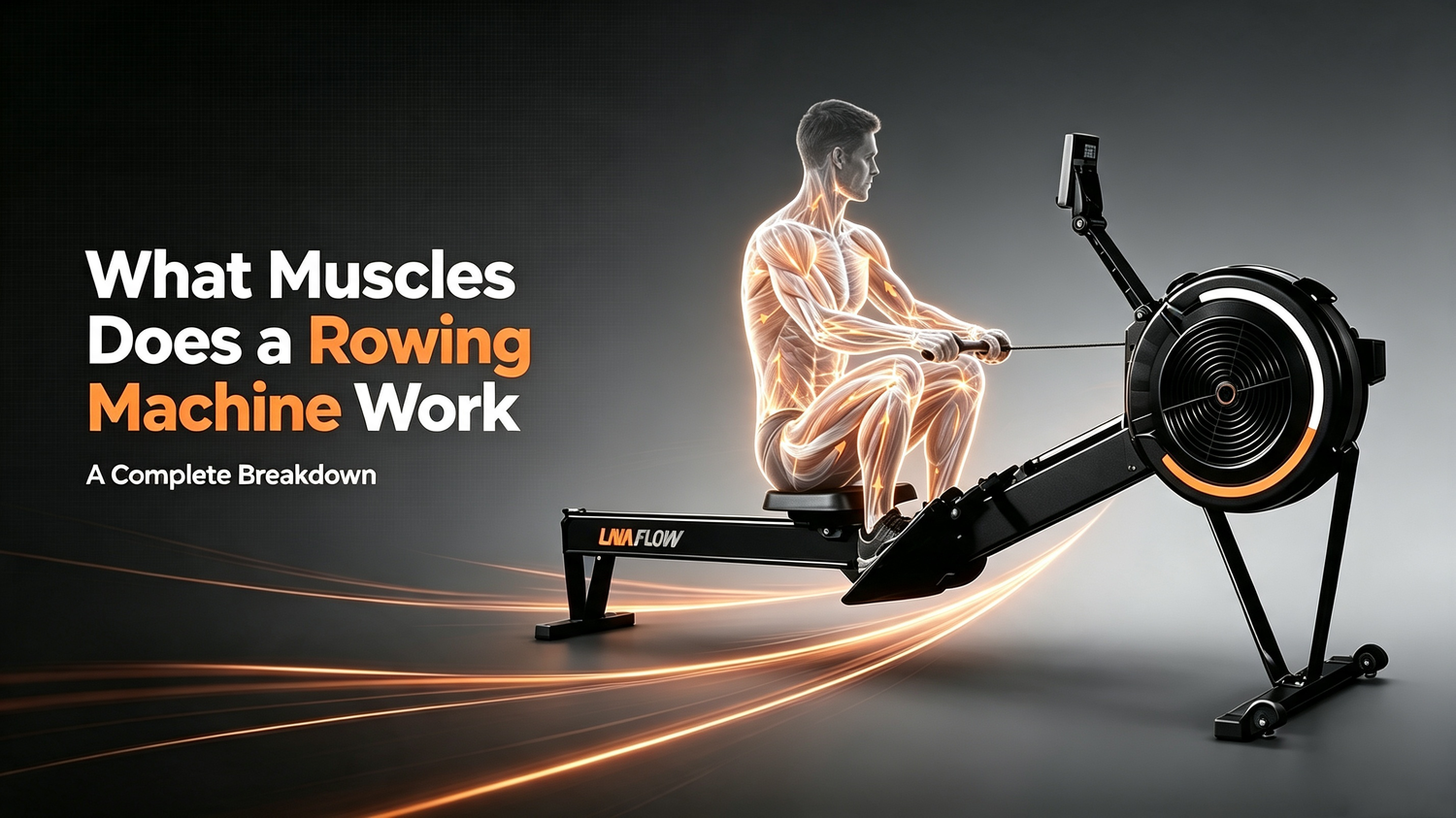
A rowing machine looks simple, but it puts almost your whole body to work. Each stroke uses your legs, back, arms, and core in one smooth motion. This makes rowing different from machines that only target one area, like a bike or a treadmill.
Rowing works your legs, back, arms, shoulders, and core, with your legs providing most of the power in each stroke. As you push off with your legs, your back and arms pull the handle toward your body. Your core stays active the whole time to keep you balanced and stable.
If you want to know exactly which muscles work during each part of the stroke, this guide breaks it down step by step. You'll learn what happens at the catch, the drive, the finish, and the recovery. By the end, you'll understand why rowing is often called one of the most complete workouts you can do.
Primary Muscle Groups Engaged
Your legs do most of the work when you row, but your back, core, and arms all play key roles too. Each phase of the stroke calls on a different set of muscles to keep the movement smooth and powerful.
Back And Shoulder Muscles
Your back muscles kick in hard during the drive and finish of each stroke. The latissimus dorsi (lats) pull the handle toward your body, while your trapezius and rhomboids work together to pull your shoulder blades back.
Your rear deltoids also help finish the stroke by pulling your arms back and up. This combination builds a strong, defined back over time.
Good posture matters here. If you round your shoulders forward, you lose power and put stress on your lower back instead of your target muscles.
Leg And Hip Muscles
Your legs generate most of the force in each stroke. The quadriceps in your thighs push you back on the drive, while your hamstrings and glutes help extend your hips.
Your calves also get involved at the start of each stroke, helping stabilize your feet against the footplate. Together, these muscles account for roughly 60% of the total effort in a rowing stroke.
This leg-driven power is what makes rowing different from many other cardio machines. You're not just pulling with your arms—you're pushing with your whole lower body.
Core Stabilizers
Your core muscles don't move the handle, but they keep your body stable and connected during each stroke. Your abdominals and obliques work to transfer power from your legs to your upper body.
Without a strong core, energy leaks out during the transition between the leg drive and the pull. Your lower back muscles, including the erector spinae, also stay engaged to protect your spine and keep your torso upright.
This constant engagement is why rowing builds core strength even though it's not a typical ab exercise.
Arm Muscles
Your arms finish each stroke by pulling the handle to your chest. The biceps bend your elbows during this final pull, while your forearms grip the handle throughout the entire stroke.
Your triceps also activate during the recovery phase, as you extend your arms back out to reset for the next stroke. While your arms don't generate as much power as your legs, they play a key role in controlling the handle and finishing the stroke with proper form.
How Rowing Technique Affects Muscle Activation
Your form on the rowing machine controls which muscles do the work. Small changes in timing and posture shift effort between your legs, back, and arms.
The Drive Phase
The drive is where you push power into the stroke. It starts with your legs, moves through your core, then finishes with your arms.
If you rush this order, you lose power and put too much strain on your lower back. Push through your heels first. Let your legs extend fully before you lean back or pull with your arms.
Your quads and glutes handle most of the load here. Your core stays braced to transfer that power up through your back and shoulders.
Skipping the leg drive and pulling too early with your arms is a common mistake. This shifts stress to your shoulders and lower back instead of your stronger leg muscles.
The Recovery Phase
The recovery phase happens as you slide back to the starting position. Your muscles work here too, just in reverse order and with less intensity.
Your arms extend first, then your body hinges forward, and your knees bend last. This sequence protects your knees and keeps tension off your lower back.
Your hamstrings and hip flexors control the pace of your slide. Moving too fast during recovery wastes energy and can throw off your balance for the next stroke.
Key recovery checkpoints:
- Arms extend before your hips break
- Hips fold forward before your knees bend
- Shins stay vertical when your knees bend fully
Resistance And Workout Intensity
The resistance setting on your machine changes how your muscles respond to each stroke. Cranking up the resistance means you’ve gotta push harder with every pull, firing up more muscle fibers in your legs and back.
Dialing it down lets you row at a faster clip, shifting the focus toward cardio. Sure, your muscles are still working, but the strength-building side takes a bit of a backseat.
| Resistance Level | Primary Effect |
|---|---|
| Low | Higher stroke rate, more cardio focus |
| Medium | Balanced strength and endurance |
| High | Greater force per stroke, more muscle recruitment |
Technique kind of trumps everything, though. No matter how high the resistance, sloppy form means your muscles just aren't getting the most out of each stroke.


Dejar un comentario
Todos los comentarios se revisan antes de su publicación.
Este sitio está protegido por hCaptcha y se aplican la Política de privacidad de hCaptcha y los Términos del servicio.