










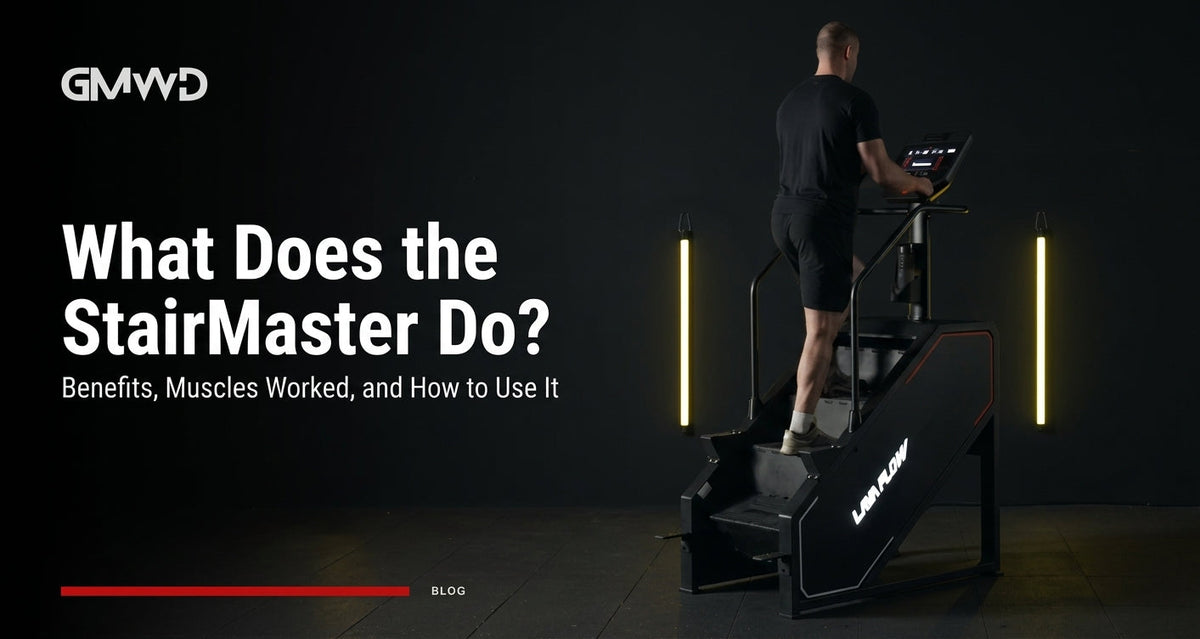
Thirty minutes on a treadmill can be a breeze. Thirty continuous minutes on a revolving flight of stairs, however, will humble almost anyone.
A stair climber (or stepmill) makes you lift your body weight against gravity with every step. There's no flat stretch to coast through, and your legs don't get much of a break. That simple movement makes it a tough combination of cardio and lower-body endurance work.
But is it really as good as people make it sound? What muscles are doing the work, and can climbing stairs actually build your glutes? Here's what the machine does well, what it won't do for you, and how to get a worthwhile workout without turning every session into a survival test.
The Bottom Line
- Cardio: Stair climbing gets your heart rate up quickly and gives you a demanding cardiovascular workout.
- Muscles Worked: Your glutes, quads, and calves do most of the work. Your hamstrings and core help with the movement and keep you stable.
- Muscle Growth: It builds leg endurance, but it won't replace heavy squats, hip thrusts, or other resistance exercises if you're trying to add muscle.
- The Golden Rule: Don't hang your body weight on the handrails. Use them for balance, and slow down if you can't keep your posture under control.
What Does a Revolving Stair Climber Actually Do?
A revolving stair climber is different from the little stepper with two pedals you might have seen under someone's desk. Instead of pushing two separate platforms up and down, you're climbing a moving staircase. The steps keep coming, so you have to keep moving with them.
That's why even a fairly slow setting can feel harder than expected. Your legs are repeatedly lifting your body weight, while your heart and lungs work to keep up.
People generally use the machine for three reasons:
- Cardiovascular conditioning: Your heart rate can climb quickly because large muscle groups are working continuously. Pick a slower pace for a steady session or increase the speed when you're ready for a harder effort.
- Leg endurance: Climbing over and over builds the kind of stamina that comes in handy on steep hikes, long staircases, and other activities that keep your legs working.
- Calorie expenditure: Your legs are doing a lot of work, and there's very little downtime. That makes the stair climber a demanding cardio option, though the number of calories you burn will depend on your weight, pace, and time on the machine.
What Muscles Are Doing the Work?
Your legs take most of the workload. The glutes and quads are especially involved in driving you upward, while the calves help control each step. Your core has a quieter job: keeping your body steady while your weight shifts from one leg to the other.

| Muscle Group | What It Does During Stair Climbing |
|---|---|
| Glutes | Help extend the hips and drive you upward |
| Quads | Straighten the knees as you step up |
| Calves | Control ankle movement and help push through each step |
| Hamstrings | Assist hip extension and stabilize the knees |
| Core | Keeps your torso steady and helps maintain balance |
A quick note on glute growth: Stair climbing can make your glutes work hard, but that doesn't automatically mean bigger glutes. A long cardio session is not the same as progressively loading a muscle for growth. If building muscle is the goal, keep hip thrusts, squats, and Romanian deadlifts in your routine. The stair climber is better used alongside that work than in place of it.
Key Benefits of Training on the Stairs
1. A Tough Cardio Session Without Running
You don't have to run to get your heart rate up. Stair climbing can be demanding at a relatively modest speed because your legs are constantly working against gravity.
It also involves less repetitive landing impact than running on a treadmill or pavement. That doesn't make it stress-free for your joints, though. Your knees still have to handle repeated bending and loading, especially as the pace increases. If running bothers you, the stair climber may be worth trying, but start slowly and see how your body responds.
2. Better Leg Endurance
Heavy lifting and stair climbing are two different challenges. A set of heavy squats tests how much force your legs can produce. A longer stair-climbing session tests how long they can keep working.
That repeated effort is useful for anyone who hikes, climbs hills, or spends a lot of time on their feet. You won't suddenly become a better hiker after one session, but building endurance in your legs is a practical reason to use the machine.
3. A Useful Tool for Weight Management
Stair climbing can burn a meaningful number of calories in a relatively short session, particularly when you keep a steady pace. But no machine guarantees fat loss.
If weight loss is your goal, the bigger picture still matters: your overall calorie intake, activity level, and consistency over time. Treat the calorie number on the console as a rough estimate, not an exact measurement of what you've burned.
Form Check: Stop Leaning on the Handles
You have probably seen it at the gym: someone leaning over the console, gripping both handles, and practically hanging there while the stairs keep moving.
The problem isn't using the handles. It's relying on them to carry your weight. When you pull yourself forward or rest heavily on your arms, your legs don't have to do as much work, and your posture can fall apart.
A few things to keep in mind:
- Keep your chest up and look ahead. There's no need to stare at your feet the whole time.
- Use the rails for balance, not as a place to rest your upper body.
- Step far enough onto each stair to get a stable footing. Don't rush through the movement on your toes.
- Keep your steps controlled rather than bouncing from one step to the next.
- If you need to lean heavily on the handles to keep going, the speed is probably too high. Lower it.
And don't feel that you have to keep your hands completely off the rails to prove anything. A light grip is fine, and extra support is sensible whenever you need it.
"Use the rails for balance, not as a place to rest your upper body. If you need to lean heavily on the handles to keep going, the speed is probably too high."
3 Practical Workouts
You don't need to spend an hour on the stair climber to get something out of it. The right session depends on your fitness level and what you're trying to improve.
1. The Aerobic Base Builder (Steady State)
Best for beginners or anyone who wants a manageable cardio session.
- Warm-up: 3 minutes at a slow pace.
- Working set: 12–18 minutes at a speed that gets you breathing harder but still lets you speak in short sentences.
- Cooldown: 2–3 minutes at an easy pace.
Don't worry about chasing a high speed. The point is to keep moving at a pace you can sustain.
2. High-Intensity Interval Training (HIIT)
Best for experienced users who want a shorter, more demanding session.
- Warm-up: 4 minutes at an easy pace.
- Hard climb: 30 seconds at a brisk but controlled speed.
- Recovery: 60–90 seconds at a slower pace.
- Rounds: Repeat 6–8 times.
- Cooldown: 3 minutes at an easy pace.
The hard intervals should feel challenging, not reckless. If you're stumbling, leaning on the handles, or struggling to place your feet, back off the speed.
3. The Slow-Burn Endurance Grind
Best for hiking preparation and building stamina.
- Warm-up: 5 minutes, gradually increasing your speed.
- The Climb: 20–25 minutes at a steady, moderate pace.
- Cooldown: 3–5 minutes at an easy pace.
This one is less about speed and more about holding a consistent effort. Start at a pace you can maintain instead of going too hard in the first five minutes.
Stair Climber vs. Treadmill
Both machines can give you a solid cardio workout, but they don't feel the same.
| Feature | Stair Climber | Treadmill |
|---|---|---|
| Primary Motion | Climbing a revolving staircase against gravity | Walking or running on a flat or inclined belt |
| Muscle Demand | Greater emphasis on sustained work from the glutes and quads | Works the legs and hips through walking or running |
| Joint Impact | Less repetitive landing impact than running, but still demanding on the knees and legs | Walking is relatively low impact; running involves repeated landing forces |
| Best Used For | Climbing endurance, leg conditioning, and cardio | Walking, running, incline training, and race preparation |
Neither machine is automatically better. If you're training for a 5K, the treadmill makes more sense. If you want to get better at climbing and challenge your legs without running, the stair climber is a good option.
StairMaster, Stair Climber, and Stepmill: Are They the Same?
You'll see these names used interchangeably, especially in gym conversations, but there are small differences.
StairMaster is a brand name that people often use when talking about revolving stair-climbing machines. Stair climber is the broader term, while stepmill usually refers to the machine with a continuous rotating staircase.
A traditional mini stepper is a different piece of equipment. It has two independent pedals that move up and down rather than a revolving set of stairs. If you're shopping for one, check the machine's design rather than assuming every product called a stepper offers the same workout.
Bringing the Machine Home: GMWD Models Compared
If you're considering a revolving stair climber for a home gym or training facility, GMWD has two commercial-style models worth comparing. They share the basic climbing motion, but their controls and workout options are different.
GMWD LAVA FLOW™ Commercial Stair Climber PRO SS03
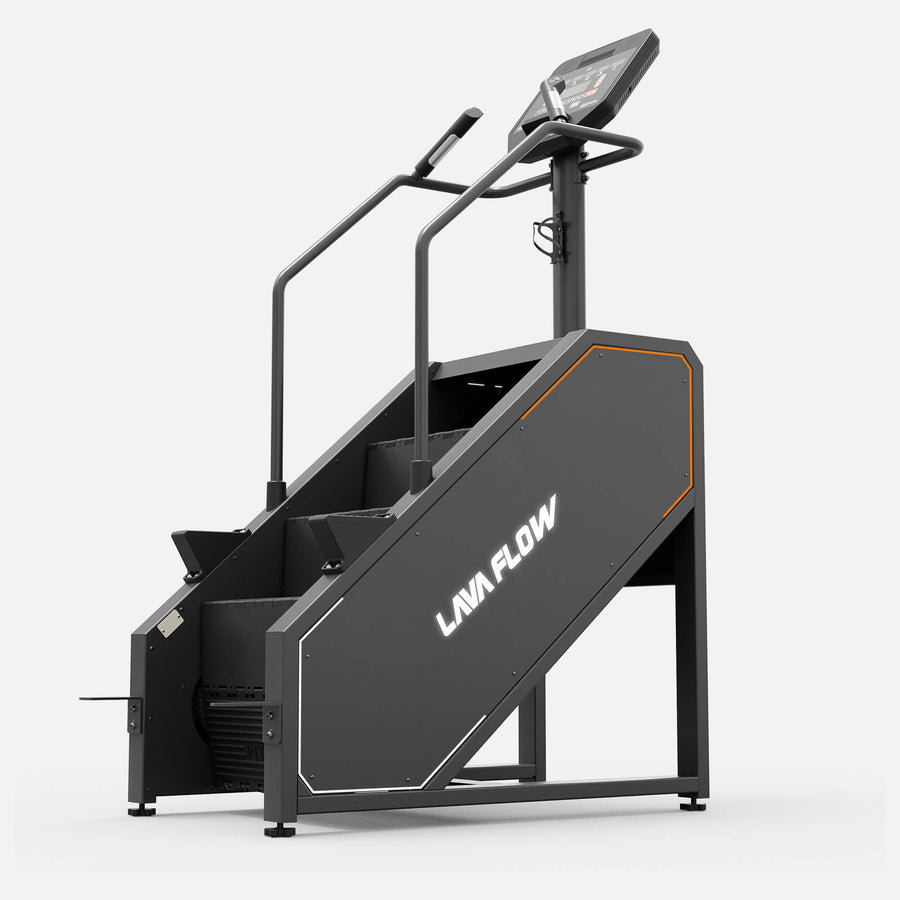
The SS03 gives you a broad range of speed settings, which is useful if more than one person will be using the machine or you want room to progress.
- 15 speed settings: Covers a step rate of 24–164 steps per minute.
- Four full-size revolving steps: Each step measures 21.6" wide × 9.1" deep.
- Handlebar controls: Adjust speed and manage your workout without reaching for the console.
- Extra features: Includes an infrared safety sensor, emergency stop system, cooling fan, Bluetooth connectivity, and an LED display.
GMWD Commercial Stair Climber SS02

The SS02 takes a more program-focused approach, with built-in options for users who prefer a guided workout rather than adjusting the pace manually throughout the session.
- 15 resistance levels: Offers different levels of workout intensity.
- Built-in programs: Includes 8 preset programs and 4 targeted programs.
- Floor space: Takes up approximately 11.25 sq. ft.
- Safety features: Includes non-slip steps, infrared safety sensors, manual emergency stop buttons, and an electromagnetic braking system.
Before you order: These machines need more than floor space. GMWD recommends a ceiling height of approximately 8'8"–9'8", depending on the model and the user's height. Measure from the floor to the ceiling before ordering, and leave enough room for a comfortable climbing position.
Frequently Asked Questions
You can, but that doesn't mean you need to. If you're also doing heavy leg workouts, daily stair climbing may leave your quads and calves with little time to recover. For most people, starting with 2–3 sessions per week is a reasonable approach. Adjust from there based on how your legs feel and what else is in your training schedule.
No. You can't choose where your body loses fat by choosing a particular exercise. Stair climbing burns calories, which can contribute to overall fat loss when you're consistently in a calorie deficit. Your body decides where that fat comes off.
A traditional mini stepper has two independent pedals that move up and down. A revolving stair climber has a motorized staircase that keeps moving beneath you. You have to lift your feet and climb each step, so the movement and balance demands are different.
It depends on what you want from your workout. The stair climber puts more emphasis on continuous climbing and lower-body endurance. The treadmill is the more practical choice for walking, running, and race-specific training. If you enjoy both, there's no reason to limit yourself to one.


Leave a comment
All comments are moderated before being published.
This site is protected by hCaptcha and the hCaptcha Privacy Policy and Terms of Service apply.